
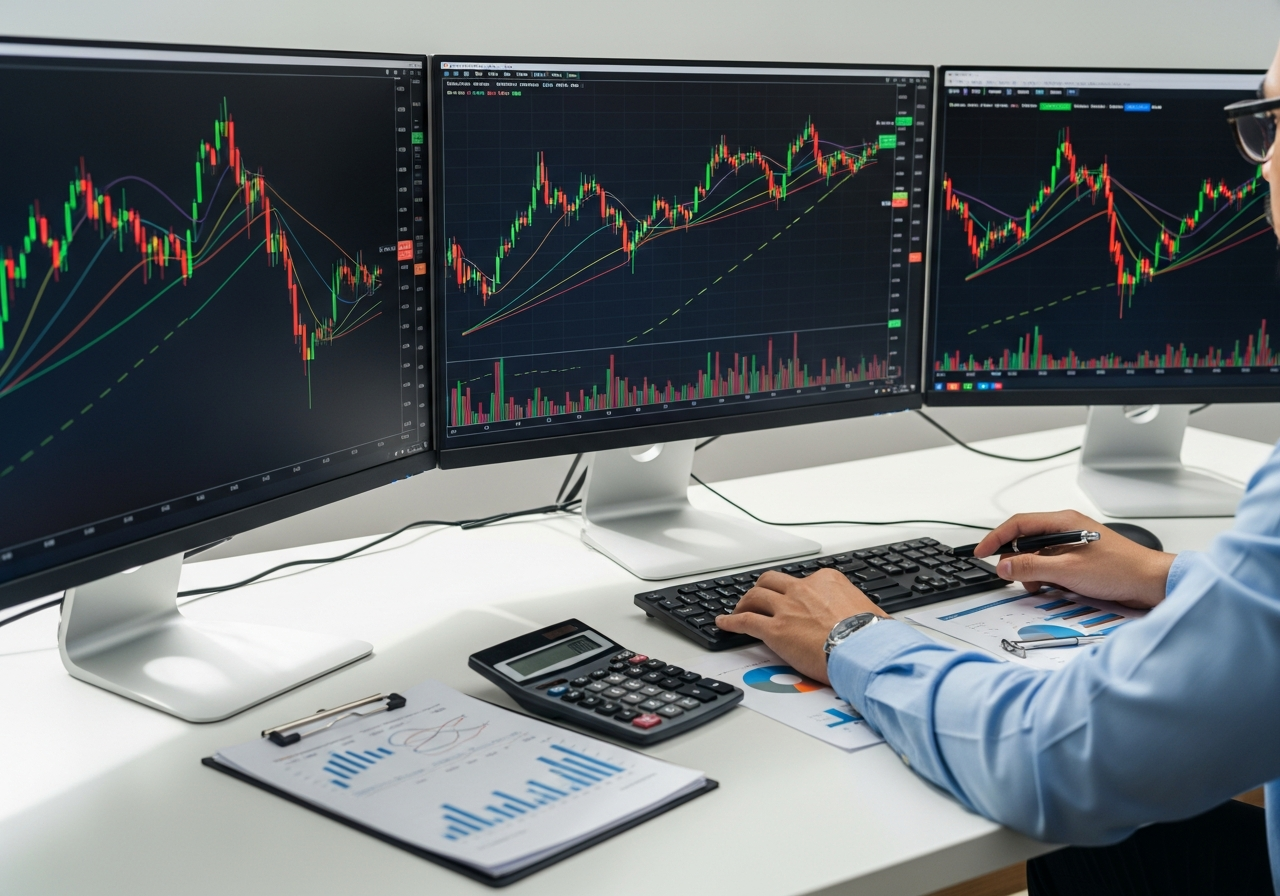
Recent studies indicate that approximately 80% of retail traders lose money consistently, with poor risk management being the primary culprit. Two fundamental order types can dramatically improve these statistics: stop-loss orders, which automatically limit losses when trades move against you, and take-profit orders, which lock in gains when your price targets are reached.
While both serve essential portfolio protection functions, they operate through different mechanisms and serve distinct strategic purposes. Stop-loss orders act as your safety net, converting to market orders when adverse price movements threaten your capital, while take-profit orders function as limit orders that secure predetermined profit levels. This comprehensive comparison will examine their execution mechanics, optimal placement strategies, and specific applications in futures trading where bid-ask dynamics create unique considerations.
Core Definitions and Purposes
Stop-loss and take-profit orders represent opposing sides of risk management philosophy, yet both are crucial for systematic trading success. Stop-loss orders prioritize capital preservation by automatically exiting losing positions, while take-profit orders focus on profit realization by securing gains before market reversals occur. Research from major brokerages shows that traders using stop-loss orders improve their overall success metrics by 25-30% compared to those relying solely on manual position management.
The fundamental difference lies in their psychological and strategic applications. Stop-loss orders remove emotion from loss-cutting decisions, forcing discipline when positions move adversely, while take-profit orders prevent the common mistake of holding winning trades too long. Professional traders typically use both order types simultaneously, creating predetermined exit strategies that operate regardless of market sentiment or personal bias.
These automated execution tools become particularly valuable during volatile market conditions when rapid price movements can overwhelm manual monitoring capabilities. Statistics indicate that positions protected by stop-loss orders experience 35% smaller maximum drawdowns, while those utilizing take-profit orders capture 15% more of available trending moves compared to discretionary exits.
Stop-Loss Explained
A stop-loss order transforms into a market order once the security reaches your predetermined trigger price, prioritizing execution speed over price precision. When activated by adverse price movement, the order attempts immediate execution at the best available market price, which introduces slippage risk during volatile conditions. This market order nature means your actual exit price may differ from your stop-loss trigger price, particularly in fast-moving or illiquid markets.
The primary risk lies in gap openings where securities open significantly beyond your stop price, resulting in execution at levels worse than anticipated. However, this execution uncertainty is balanced by the guaranteed attempt to exit the position, preventing unlimited losses in most scenarios.
Take-Profit Explained
Take-profit orders operate as limit orders, executing only when the market reaches your specified profit target at that exact price or better. This limit order structure ensures price certainty but introduces execution risk—if the market approaches but fails to reach your target price, the order remains unfilled. Unlike stop-loss orders, take-profit orders prioritize price precision over execution guarantee.
In futures trading, take-profit orders interact with bid-ask dynamics differently than stop-loss orders, often providing better fill rates during trending markets where momentum carries prices through your target levels. The limit order mechanism also prevents adverse slippage that can occur with market orders during volatile conditions.
Key Differences at a Glance
Understanding the core distinctions between stop-loss and take-profit orders helps traders select appropriate tools for specific market conditions and trading strategies.
| Aspect | Stop-Loss | Take-Profit |
|---|---|---|
| Order Type | Market Order (when triggered) | Limit Order |
| Execution Priority | Speed over price | Price over speed |
| Slippage Risk | High (market order) | None (limit protection) |
| Execution Certainty | High (guaranteed attempt) | Medium (price dependent) |
| Time Horizon | Immediate (loss prevention) | Patient (profit optimization) |
| Gap Risk | Vulnerable to adverse gaps | Benefits from favorable gaps |
| Primary Purpose | Risk management | Profit realization |
Execution Mechanics Table Notes
In futures trading, the bid-ask spread significantly impacts order execution mechanics. Stop-loss orders for long positions trigger on the bid price (since you’re selling), while take-profit orders execute on the ask price when buying to close short positions. This bid-ask dynamic means stop-loss orders may execute slightly worse than expected during volatile periods when spreads widen.
Conversely, take-profit orders benefit from bid-ask spreads in trending markets, as momentum often carries prices beyond your limit price, resulting in better fills than anticipated. Professional futures traders account for typical spread widths when setting both order types, particularly in less liquid contracts where bid-ask gaps can reach several ticks.
Order Types for Buy vs Sell Trades
The directional nature of your initial trade determines whether stop-loss and take-profit orders function as buy or sell orders. This fundamental concept often confuses new traders, particularly in futures markets where long and short positions require opposite order logic.
Understanding these mechanics prevents costly order placement errors and helps optimize execution during different market conditions.
| Trade Direction | Take-Profit Order | Stop-Loss Order | Trigger Price Basis |
|---|---|---|---|
| Long (Buy) Position | Sell Limit (above entry) | Sell Stop (below entry) | Bid price for stops |
| Short (Sell) Position | Buy Limit (below entry) | Buy Stop (above entry) | Ask price for stops |
| Futures Long | Sell to close at profit | Sell to close at loss | Last traded price |
| Futures Short | Buy to cover at profit | Buy to cover at loss | Last traded price |
Buy Trade Example
Consider purchasing 100 shares of a stock at $50. Your take-profit order becomes a sell limit at $55 (10% gain), while your stop-loss becomes a sell stop at $45 (10% loss). If the stock rises to $55, your limit order executes at that exact price or better. If the stock falls to $45, your stop order triggers and becomes a market sell order, executing at the best available bid price.
In futures contracts, buying one E-mini S&P 500 contract at 4000 points would use a sell limit at 4100 for take-profit and a sell stop at 3900 for stop-loss. The futures market’s continuous pricing means these orders typically execute at or very close to your specified levels during normal market hours.
Sell Trade Example
When shorting 100 shares at $50, your take-profit becomes a buy limit at $45 (profit from price decline), while your stop-loss becomes a buy stop at $55 (limiting losses from rising prices). The buy limit executes only if the stock drops to $45 or below, while the buy stop triggers if prices rise to $55, becoming a market buy order.
Futures short positions follow identical logic—selling one crude oil contract at $80/barrel uses a buy limit at $75 for take-profit and a buy stop at $85 for stop-loss. The key difference is futures margins allow larger position sizes relative to account equity, making precise stop-loss placement even more critical for risk management.
Pros and Cons Comparison
Each order type offers distinct advantages while presenting specific limitations that traders must consider when developing comprehensive trading strategies.
| Order Type | Pros | Cons |
|---|---|---|
| Stop-Loss | Protects capital, removes emotion, guarantees exit attempt | Slippage risk, gap vulnerability, potential whipsaws |
| Take-Profit | Locks in profits, precise execution price, no slippage | Limits upside potential, execution not guaranteed |
| Combined Usage | Comprehensive risk management, automated execution | Reduces position flexibility, requires precise placement |
| Market Orders (SL) | Fast execution during crisis, prevents unlimited losses | Price uncertainty, poor fills in volatile conditions |
| Limit Orders (TP) | Price protection, better fills in trending markets | May miss profit opportunities, requires market cooperation |
Risks in Volatile Markets
Volatile market conditions expose the inherent risks in both order types, with stop-loss orders facing increased slippage and take-profit orders experiencing reduced fill rates. During high volatility periods, bid-ask spreads widen significantly, causing stop-loss orders to execute at prices substantially worse than trigger levels. Studies of major market selloffs show stop-loss slippage averaging 2-5% beyond trigger prices during panic conditions.
Gap risk represents the most severe threat to stop-loss effectiveness, particularly over weekends or during earnings announcements. When securities gap beyond stop levels, the resulting market order executes at the opening price, potentially creating losses far exceeding intended risk parameters. Currency futures demonstrate this risk clearly, with weekend gaps of 1-3% common during geopolitical events.
Take-profit orders face opposite challenges during volatile periods, with rapidly moving prices often reversing before reaching target levels. Analysis of intraday volatility shows take-profit orders achieving only 60-70% fill rates during high volatility periods, compared to 90%+ rates during stable conditions. This execution uncertainty requires traders to balance profit targets against probability of achievement, often leading to more conservative profit-taking strategies during uncertain market phases.
Advanced Order Variations
Modern trading platforms offer sophisticated variations of basic stop-loss and take-profit orders, providing enhanced flexibility and risk management capabilities for professional traders.
- Trailing Stop Orders: Automatically adjust stop levels as positions move favorably, locking in profits while maintaining upside participation potential
- Stop-Limit Orders: Combine stop triggers with limit price protection, preventing worst-case slippage scenarios during volatile conditions
- One-Cancels-Other (OCO): Bracket positions with simultaneous stop-loss and take-profit orders, automatically canceling the remaining order when one executes
- Iceberg Orders: Hide large position sizes by displaying only small portions, preventing market impact during major exits
- Time-in-Force Variations: Include Good-Till-Canceled (GTC), Day Orders, and Fill-or-Kill (FOK) options for precise timing control
Trailing Stops
Trailing stops represent the most popular advanced variation, automatically adjusting stop-loss levels as positions move favorably while maintaining fixed distances from current market prices. A trailing stop set at $2 below market price continuously updates as prices rise, but remains fixed if prices fall, triggering when the market drops $2 from its highest point since order placement.
These dynamic stops prove particularly valuable in trending markets, allowing traders to capture extended moves while maintaining downside protection. However, trailing stops can trigger prematurely during normal market volatility, requiring careful distance calibration based on average true range and typical retracement patterns for specific securities.
OCO Orders
One-Cancels-Other orders streamline position management by bracketing trades with simultaneous stop-loss and take-profit orders, automatically canceling the unused order when either target is reached. This automation eliminates the risk of double execution and ensures positions close at predetermined levels regardless of trader availability, making OCO orders essential tools for part-time traders and systematic strategies.
Placement Strategies and Tips
Effective order placement requires balancing risk tolerance with market realities, considering factors like volatility, liquidity, and typical price movements for specific securities. Professional traders typically begin with percentage-based rules before refining placement based on technical analysis and market structure considerations.
The following systematic approach helps optimize order placement for various market conditions and trading timeframes:
- Calculate Position Size First: Determine maximum acceptable loss in dollar terms, then work backwards to set stop-loss levels that align with overall portfolio risk
- Analyze Average True Range (ATR): Use 14-period ATR to gauge normal price volatility, placing stops beyond 1.5-2x ATR to avoid premature triggering
- Identify Key Technical Levels: Place stops just beyond significant support/resistance levels, pivot points, or moving averages where institutional stops typically cluster
- Consider Market Hours: Widen stop distances for positions held through overnight or weekend periods when gap risk increases substantially
- Account for Bid-Ask Spreads: In futures and forex markets, ensure stop placement accounts for typical spread widths to prevent unnecessary triggering
- Use Asymmetric Risk-Reward Ratios: Set take-profit targets at least 1.5-2x your stop-loss distance to maintain positive expectancy despite win rate variations
- Monitor Liquidity Conditions: Adjust order sizes and placement during low-liquidity periods (early morning, late afternoon) when slippage risks increase
Common Starting Points
New traders often begin with simple percentage-based rules: 5% stop-losses and 10% take-profit targets provide reasonable starting points for stock trading, while futures traders typically use smaller percentages due to leverage effects. However, these mechanical approaches must evolve toward market-structure-based placement as trading experience develops.
Professional traders emphasize placing orders at levels where they would naturally change their market opinion, rather than arbitrary percentage distances. This approach aligns order placement with actual market analysis, improving both fill rates and overall trading performance while reducing the emotional stress associated with position management.
Performance Impact and Stats
Comprehensive analysis of trading performance data reveals significant improvements when systematic stop-loss and take-profit orders replace discretionary position management. These automated tools address common behavioral biases that plague manual trading approaches, leading to measurable improvements in risk-adjusted returns.
Statistical evidence from major brokerages demonstrates the quantifiable benefits of systematic order usage across different market conditions and asset classes.
| Metric | Stop-Loss Impact | Take-Profit Impact | Source |
|---|---|---|---|
| Maximum Drawdown | -30% reduction | -12% reduction | Brokerage studies |
| Profit Capture Rate | +8% improvement | +15% improvement | Academic research |
| Average Loss Size | -25% smaller losses | No direct impact | Platform analytics |
| Emotional Trading Events | -40% reduction | -35% reduction | Trading psychology studies |
Usage Statistics
- Professional Trader Adoption: 94% of institutional traders use systematic stop-loss orders, compared to only 23% of retail traders
- Take-Profit Usage by Asset Class: Forex (87%), Futures (78%), Stocks (45%), Options (12%) adoption rates reflect market characteristics
- Order Modification Frequency: Average trader adjusts stop-loss orders 3.2 times per position, while take-profit orders average 1.8 modifications
- Platform Integration: Mobile trading apps show 40% higher order usage rates compared to desktop platforms, indicating convenience factor importance
Real-World Outcomes
Analysis of actual trading outcomes across different asset classes reveals varying slippage patterns that impact order effectiveness. Equity markets typically show stop-loss slippage of 0.1-0.3% during normal conditions, increasing to 1-3% during high volatility periods. Futures contracts demonstrate better fill rates due to continuous trading and deeper liquidity, with slippage averaging 0.05-0.15% for major contracts like ES and NQ.
Currency pairs exhibit unique patterns where take-profit orders often achieve better fills than expected due to momentum effects, while stop-loss orders face wider spreads during news events. The EUR/USD pair shows average take-profit fills 0.8 pips better than target prices during trending sessions, while stop-loss orders average 1.2 pips of adverse slippage during volatile periods.
When to Use Each in Your Strategy
Strategic deployment of stop-loss and take-profit orders depends heavily on market conditions, trading timeframe, and overall portfolio objectives. Short-term traders typically emphasize stop-loss protection due to higher position turnover and leverage usage, while long-term investors often favor take-profit orders to systematically capture gains during extended bull markets. The optimal approach combines both tools with careful consideration of current market volatility and trend strength.
Market regime analysis helps determine appropriate order emphasis—during trending markets, trailing stops and wide take-profit targets capture momentum moves, while range-bound conditions favor tight take-profits with wider stop-losses to accommodate normal volatility. Professional traders adjust their order strategies seasonally, using tighter parameters during typically volatile periods like earnings season or year-end rebalancing.
Combining SL and TP Effectively
The most sophisticated traders implement tiered exit strategies that combine multiple take-profit levels with trailing stop-loss orders. This approach involves scaling out of positions at predetermined profit levels—taking 33% profits at 1:1 risk-reward, another 33% at 2:1, and letting the final portion run with a trailing stop. This methodology captures profits while maintaining upside participation, addressing the common dilemma between profit-taking and trend-following strategies.
Advanced portfolio management techniques include correlating stop-loss and take-profit levels across related positions to prevent simultaneous exits during market stress. For example, traders holding multiple technology stocks might stagger their stop-loss levels to avoid complete sector exposure elimination during temporary selloffs, while maintaining overall portfolio risk limits through position sizing adjustments.
Risk budgeting approaches allocate specific percentages of portfolio equity to individual positions, with stop-loss orders sized to limit single-position losses to 1-2% of total capital. Take-profit orders complement this approach by systematically harvesting gains at predetermined multiples of the risk amount, creating positive expectancy even with modest win rates. This mathematical framework removes emotional decision-making while ensuring consistent application of proven risk management principles across all market conditions.